
Why provide smoking cessation to cancer patients?
The following provides the reasons and evidence for the importance of smoking cessation care with oncology patients.
THE REASON FOR CANCER SERVICES
All people with cancer who smoke should have access to best practice smoking cessation care at all stages of the cancer care continuum.
Oncology health services should aim to embed a smoking cessation brief 3As model of care (COSA, 2020).
THE REASON FOR ONCOLOGISTS, SURGEONS AND PHYSICIANS
Specialists are known to ask patients about their smoking status, yet they often do not follow through with providing advice about the benefits of quitting and referral to Quitline, Nicotine Replacement Therapy, GPs or Tobacco Specialists.
The website is created to provide you with the tools to provide brief smoking cessation using the 3As model of care.
Harms & Benefits
Smoking cessation contributes to improved prognosis, reduced treatment toxicities and improved quality of life for people with cancer.
The risks of continued tobacco use after a cancer diagnosis
•The cancer can become more aggressive [1] e.g., neurological
•Increases the risk of the cancer spreading (metastasis) [2] e.g., melanoma
•Increases the risk of second primary cancer [3] e.g., head & neck, breast, melanoma
•Increase in cancer recurrence [4] e.g., lung
•Increase in cancer-related mortality [5] e.g., breast
•Increased risk of all-cause mortality [6] e.g., lung, colorectal
The benefits of quitting after a cancer diagnosis
•Reduces cancer treatment-related complications [7] e.g. lung
•Improves physical symptoms [8] e.g., oesophageal
•Improves chances of survival [9] e.g., lung
•Improves anti-cancer drug effectiveness [10] e.g. cervical
•Improves treatment outcomes [11] e.g. head & neck
•Improves post-surgery healing [12] [13] e.g., melanoma, upper GI

“...I would have taken it more seriously if my oncologist had told me to quit...”
- Suzan (35 year old)
The model

PowerPoint Presentations
-

Smoking Cessation in Cancer Services - Training (CINSW)
Why deliver smoking cessation interventions to people with cancer?
-
Smoking Cessation in Cancer Services - Training (CINSW)
Delivering the 3As Brief Intervention
-

Smoking Cessation in Cancer Services - Training (CINSW)
How to ask patients about cessation using AAA model
-

Smoking Cessation in Cancer Services - Training (CINSW)
Step 2: Advise
-

Smoking Cessation in Cancer Services - Training (CINSW)
Step 3: Act, NRT, and routine referral to Quitline
Videos

-
Oncologist Prof Graham Warren presents report findings about:
Causal relationship between cigarette smoking and increase risk of secondary primary cancers
Quitting reduces overall mortality rates
Tobacco use has a negative association with at least one outcome (e.g. survival, toxicity) across tumour streams*
*lung, head/neck, breast, gyne, hematologic, genitourinary non-prostate, prostate cancers
-
Presented by oncologist Prof Graham Warren:
Cause of death by cancer has higher hazard ratios for current smokers (prostate example)
Cessation benefits overall mortality for lung and breast cancer patients
-
Presented by oncologist Prof Graham Warren:
1st line cancer treatment failure is high for current smokers (e.g., 795 patients in NSW annually)
Financial costs are high for 1stline failure
-
Presented by oncologist Prof Graham Warren:
The Number Needed to Treat (NNT) is the number of patients you need to treat to prevent one additional bad outcome (e.g., death)
The number needed to treat for smoking is estimated 3-5 (means you need to treat 5 people who smoke to prevent one additional bad outcome)
Oncologists’ opinion about smoking cessation
-
Interview with oncologist Prof Graham Warren:
Smoking in cancer patients increases mortality
Decreases chance of 1st line treatment success
Smoking decreases effectiveness of radiation and all chemotherapy for all cancers (Head & neck, lung, breast, prostate, colon)
-
Oncologist Dr Fiona Day describes her experience of patient reactions to starting a conversation around smoking cessation
-
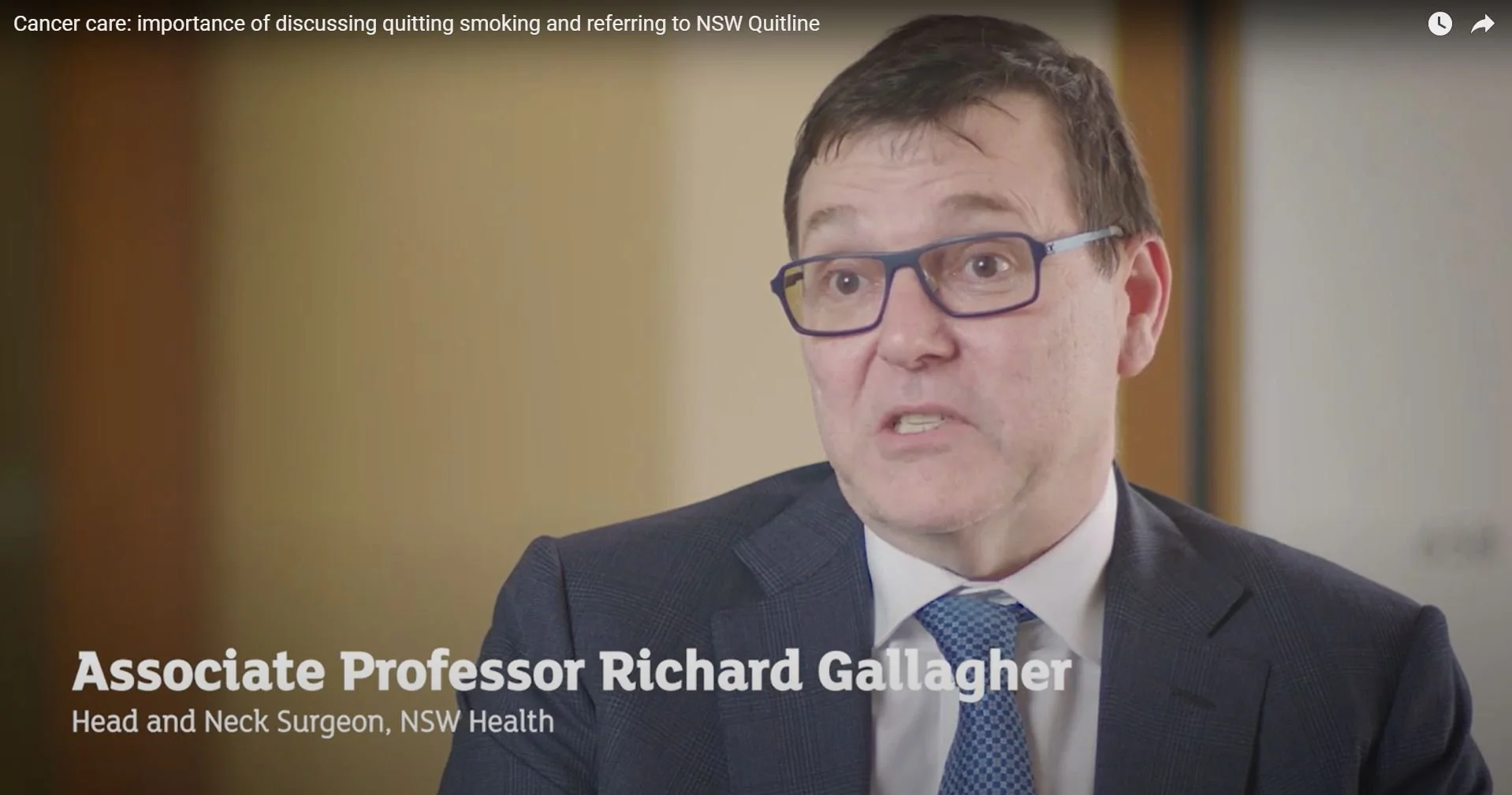
Professor Philip Beale, Veronica O’Shaughnessy and Professor Richard Gallagher talk about the importance of discussing smoking cessation with their patients and why a referral to NSW Quitline is important.
Additional videos

eVIQ overview of smoking cessation in oncology settings (1:50 min)
Quick infographic video overview of why, how and what smoking cessation services are available here: https://education.eviq.org.au/rapid-learning/archive/smoking-cessation
Factsheets
-

The clinical case for smoking cessation in cancer care (CINSW)
Benefits of smoking cessation in cancer
Negative treatment outcomes if smoking
AAA module and further advise
-

Smoking Cessation in Oncology (eviQ)
Pharmacotherapy
Benefits to patients when quitting
Risks to patients if they keep smoking
5A Model
-

WHO Tobacco and Cancer Treatment Outcomes knowledge survey
Evidence on tobacco use
Impact on treatment outcomes
References:
1. Ahn, S., et al., Cigarette smoking is associated with increased risk of malignant gliomas: A nationwide population-based cohort study. Cancers, 2020. 12(5): p. 1343.
2. Melanoma Institute Australia. Smoking linked to increased risk of melanoma spreading. 2017 22/07/21]; Available from: https://www.melanoma.org.au/research/research-news/smoking-linked-to-increased-risk-of-melanoma-spreading/.
3. Do, K.-A., et al., Second primary tumors in patients with upper aerodigestive tract cancers: joint effects of smoking and alcohol (United States). Cancer Causes & Control, 2003. 14(2): p. 131-138.
4. Florou, A.N., et al., Clinical Significance of Smoking Cessation in Subjects With Cancer: A 30-Year Review. Respiratory Care, 2014. 59(12): p. 1924-1936.
5. Passarelli, M.N., et al., Cigarette smoking before and after breast cancer diagnosis: mortality from breast cancer and smoking-related diseases. Journal of Clinical Oncology, 2016. 34(12): p. 1315.
6. Sharma, A., et al., Tobacco Smoking and Postoperative Outcomes After Colorectal Surgery. Annals of Surgery, 2013. 258(2): p. 296-300.
7. Lugg, S.T., et al., Smoking and timing of cessation on postoperative pulmonary complications after curative-intent lung cancer surgery. J Cardiothorac Surg, 2017. 12(1): p. 52.
8. Cook, M.B., et al., Cigarette smoking increases risk of Barrett's esophagus: an analysis of the Barrett's and Esophageal Adenocarcinoma Consortium. Gastroenterology, 2012. 142(4): p. 744-753.
9. Sheikh, M., et al., Postdiagnosis Smoking Cessation and Reduced Risk for Lung Cancer Progression and Mortality. Annals of Internal Medicine, 2021.
10. Eifel, P.J., et al., Correlation of smoking history and other patient characteristics with major complications of pelvic radiation therapy for cervical cancer. J Clin Oncol, 2002. 20(17): p. 3651-7.
11. Kountourakis, P., et al., Combined modality therapy of cT2N0M0 esophageal cancer. Cancer, 2011. 117(5): p. 925-930.
12. Venosa, A. History of Smoking Affects How the Body Fights Melanoma. 2019 22/07/21]; Available from: https://www.skincancer.org/blog/history-of-smoking-affects-how-the-body-fights-melanoma/.
13. Jung, K.H., et al., Preoperative smoking cessation can reduce postoperative complications in gastric cancer surgery. Gastric Cancer, 2015. 18(4): p. 683-90.